

冠泰佛 Champ Thai Fu Limited
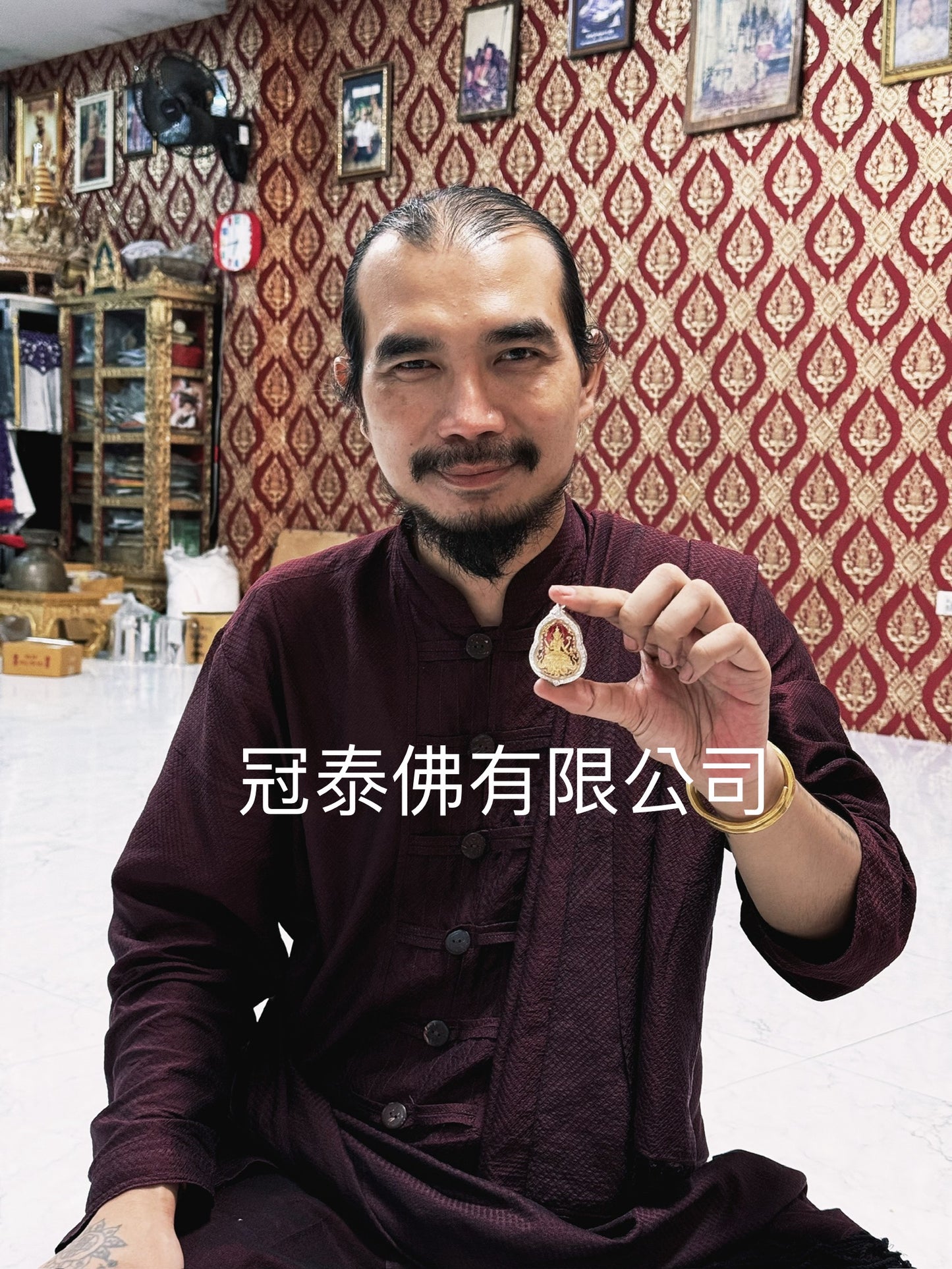
Lu Shi Kun Pi Bai Yan God of Gods Pure Silver Waterproof Case
Lu Shi Kun Pi Bai Yan God of Gods Pure Silver Waterproof Case
Couldn't load pickup availability
This is Baiyan, pronounced Payin in Mandarin, which refers to the god Indra. พระอินทร์ , the god of thunder and rain who possesses countless riches , is equivalent to the Jade Emperor, the most powerful deity in China. This is a metaphor, representing the highest god who can command all deities.
This is the Emperor amulet. The teacher said wearing this amulet will bring you a lot of money. If you've been wanting a child but haven't been able to, this amulet is very powerful for conceiving. If someone gets lost or something is lost, it can be found. It can summon lost items and even mend lost relationships. The materials added to the back are for improving your luck, changing your fortune, and removing bad luck. It's very suitable for people with low luck; it will bring you love, benefactors, and good fortune. 🍀
🩶Dominates All🩶For Children🩶For Reconciliation🩶For Dispelling Bad Luck✅Dominates All ~ The developer of wisdom, the gatherer of wealth, the companion of luck, the guide to success, the holder of power, and the guardian of health. It can grant the seeker great wisdom, overcome all difficulties, and bring unparalleled good fortune and blessings. Owning this sacred object is like having a fast track to success.
✅Seeking a child ~ Desiring a child and having one is mainly for those who have difficulty conceiving, are eager to have a child, or have few children.
✅This product helps to rekindle lost love and enhances the wearer's charismatic aura. ✨ It aids in harmonious relationships, ensures partner loyalty, and helps reconcile lost feelings, ultimately helping the wearer find their own happiness. It also attracts benefactors, bringing good fortune and wealth, both direct and indirect. It helps to recover lost wealth, making money lent out and lost luck return to you. It also helps to recover lost projects; after wearing it, bosses will be more willing to cooperate with you on previously lost projects!
✅Remove bad luck – remove bad luck, illness, drive away petty people, and win lawsuits and legal battles.
Dimensions: Approximately 4.9 cm high, 3.1 cm wide, and 1.5 cm thick.
Lersi Khunpi Kumpee holds an extremely high position within the Lersi school of magic in Northeast Thailand. He is proficient in various ancient esoteric arts, and is a successor of the Phra Pidta (goddess of destiny) and Headless Tiger magic methods. His master is considered one of the most accomplished sorcerers in Northeast Thailand and even throughout the entire country, arguably the foremost master in the region. Therefore, he is known as "the number one sorcerer in Northeast Thailand."
Ruesi (Sanskrit: Ruesi), also known as Rushi, Rujashi, Lashi, or Laersi, were ascetics in ancient India, highly accomplished meditators who lived in the forests. Ancient Ruesi resided in the Himalayas, practicing asceticism. Even today, many of these ascetic practitioners can still be found near the Himalayas in India. They did not have fixed rules of practice, but rather relied on ascetic practices as their foundation. These ascetic elders believed that as long as the body could withstand external suffering, one day they would surely attain enlightenment and become immortals.
Lersi Khun Pi, also known as Ajarn Tang, "Tang" was his childhood name. When Lersi Khun Pi was about ten years old, he became interested in magic and tattoos, but his father wanted him to study hard and become a doctor when he grew up, so he forbade him to come into contact with magic and tattoos.
Because the master was already very fascinated by magic when he was young, he secretly went to find his first master, a magic monk in the northeast. He tattooed many sakya on his back and hands, and when he got home, he showed them to his parents to show his perseverance in learning magic. Although his father was very angry, he had no choice but to send the eleven-year-old Lersi Kunpi to a temple to become a monk and learn Buddhist teachings and magic.
The master specializes in marriage-related rituals and is the third-generation successor of the authentic ancient Khmer lineage from Cambodia and Laos. His disciples come from various countries. He is a renowned figure in northeastern Thailand, having helped countless believers change their destinies, overcome difficulties, and realize their wishes!
Master Lersi Khun Pi possesses extremely high magical abilities and is highly respected in the area. He is proficient in love spells and fortune telling, and many practitioners from the Northeast visit him. Some well-known amulet makers have also hoped to become his disciples, but have not been able to (such as Ajarn Akaladi). Of all the masters he has visited, this master is the most confident in his magical abilities, and the locals have unwavering faith in his powers.
Master has many followers because he is a true inheritor of magic. Throughout his life, Lersi Khun Pi followed many different masters to learn magic, but there were several grandmasters who had a profound influence on him, such as Yong Tan Chong Thong, Bhu Lersi Solo, Bhu Lersi Am Shuai, Ajarn Thong Suk, Phra Khun Thong, etc.
He studied the "Sotham Potala" method under Bhutham Chong Thong, the "Potala" method and many other methods for improving one's luck under Bhutham Solo, and the Indian method under Bhutham Am Shuai. He received the lineage transmission from Luang Phor Suk, one of the nine great monks of Thailand. He also studied the Ten-Faced Headless Tiger method under Ajarn Thong Suk and the Phra Pidla method under Phra Khun Thong.
Master's magical lineage is the third generation of the Phuntsok lineage. His magical skill and lineage are beyond question. From a young age, he displayed extraordinary prophetic abilities, and is sought after by contemporary political figures and celebrities. He is Lersi Kumpee, a famous Thai astrologer, practitioner of ancient magic, and possesses special abilities in this century.
At his temple in northeastern Thailand, Lersi Khunpi receives local Thai devotees from various places every day, as well as foreign devotees from different countries around the world. His followers are located all over the globe, including Canada, Hong Kong, Macau, Taiwan, mainland China, Malaysia, Singapore, South Korea, the United States, Germany, and many other countries.
Every day, as always, the master sits in front of the altar at around 10 a.m., waiting for believers to come and seek assistance. Every night, he meticulously worships the Buddha, the gods, and the patriarchs and performs evening prayers. After the evening prayers, he blesses and chants for believers who have already performed rituals until around 1 a.m. He dedicates his time and work every day to magic, to religion, and to believers who are searching for themselves.
A truly virtuous and accomplished master must undergo rigorous training, possess a lineage of Dharma transmission, and have meditative abilities. Only after more than twenty years of practice can one be called "Kijak Ajarn." There are very few masters in Thailand today who are called "Kijak Ajarn." The master's Dharma assemblies are always packed with people, which shows his high standing in the eyes of believers.
Master Lersi Khunpi once said that his only passions in life were magic and building temples and statues. Several years ago, he spent approximately 20 million Thai baht (about 4.2 million RMB) to purchase land and build the largest Phra Phirat Temple in Thailand. Where did the money for the temple come from? It came from the many devotees who fulfilled their vows and donated money, goods, and even cars to the master. He used all of this money to build temples and Buddha statues, yet he lived a very simple life. He is Lersi Khunpi, and he is the best master in the hearts of the local people.
Cypress Indra
Indra, the god of thunder and rain who possesses immeasurable wealth.
Indra (Thai: 柏烟) (Sanskrit: इन्द्र, Indra), also known as Śakra, is a Hindu deity and the chief of the gods in the Vedas. He is the leader of the gods, the god of thunder and war, and the ruler of the sky. His wife is called Sāja in the Rigveda.
Indra, also known as Inda in Balinese, is a deity of the Trayastrimsa Heaven (the Thirty-Three Heavens). He resides in Sudarshana, a city atop Mount Sumeru, and leads the Four Heavenly Kings and other deities. He is called Indra, the supreme and unsurpassed ruler of the 33 Heavens, a guardian deity in Buddhism and one of the Twelve Heavenly Kings. He is the lord of Sudarshana, the Thirty-Three Heavens, and leads the Four Heavenly Kings and other beings. His other names include: Śakra, Purandara, Magava, Bhava, Kausika, Sāvapatti, Thousand-Eyed (according to the 40th volume of the Āgama, Indra possesses wisdom and can perceive a thousand meanings, hence the name Thousand-Eyed), and Indira. Furthermore, there are 108 or even 1,000 different names for Indra, according to ancient tradition.
Its form is usually that of a celestial being, seated atop a giant elephant, adorned with a thousand eyes. According to the Samyutta Nikaya, Volume 40, Indra possesses wisdom and intelligence, able to perceive a thousand meanings, hence the name "Thousand-Eyed One."
(Biography)
Originally a Hindu god, Indra was known as Sakra in ancient India. According to various scriptures, Sakra was originally a Brahmin from Magadha. Through acts of charity and other meritorious deeds, he was reborn in the Trayastrimsa Heaven and became the lord of the Thirty-Three Heavens. These accounts represent the personification of Indra's divine nature in India from the Vedic period to the Buddhist era. Buddhist scriptures say that when Shakyamuni Buddha descended, Sakra manifested a seven-jeweled golden staircase, allowing Shakyamuni Buddha to descend step by step from the Trayastrimsa Heaven. During the descent, Sakra, holding a jeweled canopy, stood to Shakyamuni Buddha's left, alongside Brahma to his right, serving as his guide.
After the Buddha attained enlightenment, Buddhism arose, and Indra became the Buddha's guardian deity, known as Indra. When the Buddha ascended to the Trayastrimsa Heaven to preach to his mother, Indra held a jeweled canopy and served as the Buddha's attendant.
(His position in Buddhism)
In Buddhism, he is the second of the "Twenty Devas" and one of the Twelve Devas. He guards the east and resides in the Trayastrimsa Heaven on the top of Mount Sumeru. His city is called Sudarshana. He is guarded by ten heavenly kings on his left and right. He once led the gods to build a multi-story lecture hall for the Buddha and the Arhats using sandalwood, and offered beds, bedding and various foods to the Buddha and his disciples. Indra often meets with the gods in his residence, Sudarshana, on Mount Sumeru, to discuss the good and evil of the world. According to the world described in Buddhism, there is a Mount Sumeru in the center of the world we live in. Indra lives in Sudarshana on the top of Mount Sumeru and rules over the other gods. There are eight gods around Mount Sumeru[5], plus Indra in the center, which makes thirty-three gods. This is the Trayastrimsa Heaven, one of the six heavens of the Desire Realm. According to Buddhism, anyone who does good deeds can be reborn in Indra. Indra, the supreme deity, considers one hundred days in the human realm as one day, and his lifespan is one thousand years, which is equivalent to one hundred thousand years in the human realm. Legend has it that Shakyamuni Buddha himself was reborn as Indra more than thirty times.
(Main Responsibilities)
As a guardian deity, his primary duty is to protect the Buddha, the Dharma, and the monastic community. For example, when the Buddha was meditating under the tree, demons attacked and disturbed his meditation; Indra then blew a conch shell to protect the Buddha. When the Buddha entered Nirvana, Indra appeared again, reciting hymns. He also protected the Buddha's relics. Stories about Indra's life in the Buddha's life frequently appear in Buddhist art, where Indra is often depicted holding a jeweled canopy, attending to Shakyamuni alongside Brahma.
Share